
3D printing materials
A wide range of materials makes it possible to meet a broad spectrum of requirements and applications. From plastics, metals, glass, sand, wood, biomaterials, resins, and ceramics to innovative composite materials, 3D printing offers the right solution for your needs in your field.
plastic
Resin
metal
Other
PETG
PP
TPU
PCTG
PC
HIPS
PVC
PC-ABS
PVB
PPS
PE
ULTEM 1010
ULTEM 9085
PPSU
PPSF
standard
Tough
Flexible
Castable Wax
Rigid
High Temp
Durable Resin
Clear
ESD
High Detail
Flame Retardant
BioMed
Dental
Silicone

Stainless steel 316L 1.4404
Thanks to the unique properties of 316L stainless steel, such as its excellent corrosion and heat resistance, 3D-printed stainless steel parts are used in a wide variety of applications. In the aerospace industry, they ensure reliable performance under extreme conditions. In medical technology, they are used in the production of implants and medical instruments because they are biocompatible.

Stainless steel 17-4 PH 1.4542
3D printing with 17-4 PH stainless steel offers a range of advantages and applications. By using 3D printing technologies such as selective laser melting (SLM) or electron beam melting (EBM), this high-strength steel can be formed into complex shapes and structures that would be difficult or impossible to produce using conventional manufacturing methods.

Stainless steel PH1 1.4540
The 3D printing process allows for precise control over the design and structure of the component, which can lead to optimized material efficiency and weight reduction. This is particularly advantageous in industries such as aerospace, automotive, and medical technology, where lightweight yet robust components are required.

Aluminium AlSi10Mg 3.2382
3D printing with aluminum AlSi10Mg offers one of its key advantages: the ability to create highly complex geometries and internal hollow structures that are often difficult or even impossible to achieve with conventional methods. Furthermore, AlSi10Mg is among the most cost-effective metals for 3D printing and is ideally suited for beginners in metal 3D printing. This allows for the efficient production of components that are simultaneously lightweight, strong, and precise.

Aluminium AlSi9Cu3 3.2163
3D printing of aluminum AlSi9Cu3 offers numerous advantages. Firstly, it enables the production of components that are both strong and lightweight. This is particularly important in industries such as aerospace. Secondly, 3D printing allows for the creation of complex internal structures and cavities, leading to more efficient material use and a reduction in material consumption. Furthermore, 3D printing opens up the possibility of manufacturing customized components and accelerating prototyping.

Copper CuCr1Zr 2.1293
The combination of 3D printing and CuCr1Zr opens up applications in various fields. Lightweight yet robust components can be manufactured that meet stringent requirements. In the electronics industry, 3D printing with CuCr1Zr enables the production of housings and structures with excellent electromagnetic shielding properties.


Copper CuNi2SiCr 2.0855
3D printing with copper CuNi2SiCr offers outstanding properties such as high strength, heat resistance, and corrosion resistance, making it ideal for demanding applications. 3D printing thus opens up a wide range of possibilities in electronics, mechanical engineering, aerospace, and many other industries for the efficient and precise production of customized and unique components.

TiAl6V4v 3.7164
Using titanium as a material for 3D printing offers several advantages. Titanium is a lightweight alloy with high strength, meaning that printed objects are strong yet relatively light. This makes it particularly suitable for applications requiring low weight and high strength, such as in the aerospace industry or medical technology.

Inconel IN625 2.4856
The use of Inconel IN625 in 3D printing enables the production of customized components with high strength and durability. This opens up new possibilities in industries such as aerospace, mechanical engineering, and medical technology. 3D printing also allows for the creation of complex geometries that would be difficult or impossible to achieve with conventional manufacturing methods.

Inconel IN718 2.4668
Inconel IN718 is a high-strength nickel-chromium superalloy also used in 3D printing. In 3D printing, the material is used in powder form, which is applied layer by layer and fused together by a laser or electron beam. This process enables the production of complex components with high precision. Inconel IN718 is particularly well-suited for 3D printing due to its high strength, heat resistance, and corrosion resistance.

ABS
ABS (acrylonitrile butadiene styrene) is a commonly used material in 3D printing, especially in the FDM process. The high toughness, impact resistance, and heat resistance of ABS make it ideal for manufacturing durable parts. ABS is particularly well-suited for parts that need to be robust and chemically resistant. The flexibility of ABS allows for easy post-processing and versatile applications in 3D printing.

Have parts manufactured with TPE - TPU 3D printing
TPU (thermoplastic polyurethane) is a versatile material with high mechanical strength and abrasion resistance. It combines the properties of rubber and plastic, is flexible yet impact-resistant, and is used in various industries such as sporting goods, baby products, and general industrial applications. TPU is ideal for 3D printing and for products requiring durable and flexible properties.

PA Nylon 3D Printing - Parts Manufacturing
PA (polyamide), better known as nylon, is a proven material in 3D printing for high-strength components. Due to its excellent tensile strength and durability, nylon is ideal for manufacturing functional prototypes and end products that must withstand high mechanical stresses. Parts printed with nylon are characterized by their robustness, abrasion resistance, and reliability, making it a preferred material in additive manufacturing for demanding applications.

Aluminum oxide Al2O3
Aluminum oxide ceramic, also known as Al₂O₃, plays a role in the 3D printing of high-performance components. 3D printing with aluminum oxide enables the production of precise and robust components that can withstand extreme conditions. This advanced manufacturing technology allows for the creation of high-quality components with specific requirements for strength, durability, and chemical resistance. Aluminum oxide ceramic 3D printing offers an innovative solution for demanding applications in fields such as aerospace, medical technology, and high-performance engineering.

silicone
Silicone in 3D printing opens up new possibilities for the production of complex and customized products. The flexibility and durability of silicone make it an ideal material for the additive manufacturing of individual designs and functional prototypes. 3D printing with silicone enables the production of tailor-made products that meet specific requirements for flexibility, elasticity, and detail.

PEEK 3D printing - parts manufacturing
The combination of PEEK and 3D printing offers innovative possibilities for the production of highly precise and durable components. 3D printing with PEEK enables the manufacture of complex and customized components that exhibit both high mechanical strength and chemical resistance.

ASA 3D Printing Service - UV and Heat Resistant
We manufacture components from ASA plastic using 3D printing and also offer variants with different material combinations to meet individual requirements. ASA is distinguished by its chemical, weather, and UV resistance and is therefore ideally suited for applications in engine compartments and outdoor areas.

Tool steel MS1 M300 X3NiCoMoTi18-9-5 1.2709
The combination of tool steel 1.2709 and 3D printing technology holds great potential for the manufacturing industry. With the ongoing development of 3D printing processes and materials like this steel, this innovative combination is expected to lead to increased use in various sectors such as automotive, aerospace, and general mechanical engineering.

PLA 3D Printing Service - Everything you need to know about PLA
We offer you the option of having your components manufactured in PLA using 3D printing. If you already have a 3D file, you can use our price calculator to get an immediate quote. PLA materials are available in various combinations, each with different properties due to special additives. You can find more information about this below.

PA 11 CF Carbon fiber reinforced - carbon fiber
PA 11 carbon fiber, a high-performance material with outstanding mechanical strength, is ideally suited for the production of lightweight and stiff components as well as functional prototypes. Its high stiffness and robustness make it the preferred choice, especially in environments with extreme temperatures and heavy loads.
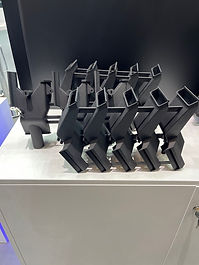
Parts manufacturing with PA6 GF30 - 3D printing service
We offer 3D printing of components made from PA6 GF30. Additionally, we can produce various nylon variants with different glass fiber content. PAGF is an engineering plastic composed of polyamide and glass fibers. This combination gives the material exceptionally high mechanical strength, stiffness, and heat resistance.
